Categories
News

Seventeen projects promoting cross-disciplinary research across the University of Georgia have been awarded 2025 Teaming for Interdisciplinary Research Pre-Seed grants.

In partnership with the Office of the Senior Vice President for Academic Affairs and Provost, the Office of Research provides pre-seed funding to facilitate interdisciplinary faculty teams and collaboration across critical and emerging research topics. To qualify, teams must consist of six to 12 faculty members from at least three disciplines.

The grants’ purpose is to jump-start interdisciplinary projects through low-dollar, high-impact pre-seed awards that prioritize relationship building and idea generation over immediate results.

ā€œThese seed grant programs incentivize teams to form around interesting new ideas, and those teams are often successful in going after other funding, even if they don’t get one of our awards,ā€ said Nate Nibbelink, associate vice president for strategic research growth in the Office of Research. ā€œIt’s been a real benefit in helping teams incubate novel research ideas and be better prepared to apply for the Presidential Interdisciplinary Seed Grant competition or other external funding.ā€

Funding is determined by the number of people on the team — $500 per faculty member — with awards averaging around $5,000. Out of 26 submitted proposals, 17 were awarded, totaling $77,000 in total funding.

Health was a recurring theme throughout several project proposals, which Nibbelink attributes to the impending launch of the university’s School of Medicine and School of Nursing.

Below is a snapshot of selected awarded projects. For a full list of the 2025 cohort, visit theĀ TIR Pre-Seed website.

Forwarding Advanced Technologies in the Health Professions: An Interdisciplinary Team Formation Initiative

Mary Frances Early College of Education Professor Matthew Schmidt will lead a project that explores the use of artificial intelligence and extended reality in health professions education. The goal is to improve how health professionals learn complex material, practice clinical decision-making and communicate across disciplines and care settings.

ā€œBy bringing together transdisciplinary expertise across pharmacy, medicine, education, engineering and artificial intelligence,ā€ Schmidt said, ā€œwe’re building the groundwork needed to pursue competitive federal funding and to position UGA as a leader in this space.ā€

Team members include Richard Lamb (College of Veterinary Medicine), Jie Lu (Mary Frances Early College of Education), Prashant Doshi (School of Computing), Kyle Johnsen (College of Engineering), Sun Joo ā€œGraceā€ Ahn (Grady College of Journalism and Mass Communication), Erica Brownfield (School of Medicine), Janette Hill (Education and Medicine) and the College of Pharmacy’s Eunice Kim, Joshua Cabellero, Michael Fulford and Susan Smith.

Cultivating Care: Advanced Therapeutic Horticulture for Georgia’s Well-being and Resilience

Jennifer Cruse-Sanders, director of the State Botanical Garden of Georgia, leads another health-related project incorporating environmental health, clinical expertise and community engagement to explore how horticulture therapy can support people living with Alzheimer’s disease. The botanical garden will serve as the project’s primary research space, while the team brings together academic research, applied practice and community outreach.

ā€œSupporting people living with dementia and their care partners through horticultural therapy requires a multifaceted approach,ā€ Cruse-Sanders said. ā€œEach team member contributes unique expertise toward our shared goals. After four years of piloting this work, seed grant funding will allow us to convene a community leadership summit to shape the project’s future direction.ā€

Team members include Cora Keber (Public Service and Outreach), Jenay Beer (College of Public Health), Sheri Dorn (College of Agricultural and Environmental Sciences), Leo Lombardini (CAES), Michelle Elliott (PSO), Sharon Liggett (PSO) and Katherine Melcher (College of Environment and Design).

Developing the One Georgia Climate and Health Extension Center

Franklin College of Arts and Sciences Professor Patricia Yager will lead an effort to build the foundation for a Georgia-wide Climate and Health Extension Center, designed to connect UGA researchers with communities across the state to address climate-related health challenges. According to Nibbelink, the project has been invited to submit a full proposal to the Burroughs Wellcome Fund. If approved, that funding will lay the groundwork for the proposed center, demonstrating how TIR funding can act as a catalyst rather than an endpoint.

Ā ā€œClimate is a universal factor affecting our health, but the solutions are complex and require interdisciplinary approaches,ā€ Yager said. ā€œThe BWF opportunity motivated us to assemble a team of UGA experts from climate, health, medicine, ecological sciences and the humanities, many of whom have never worked together before.ā€

Team members include Erin Lipp (Public Health), Allisen Penn (College of Family and Consumer Sciences), Erica Brownfield (Medicine), Pejman Rohani (Odum School of Ecology), Jonathan Mochel (CVM), Christina Fuller (Engineering), Scott Carver (Ecology), Andrew Grundstein (Franklin-Geography), Lisa Renzi-Hammond (Public Health) and Krista Capps (Ecology).

Tidal Flow: Building Experiential Data Visualization Through Art, Science and Systems Thinking

Lamar Dodd School of Art Professor Michael Marshall is teaming up with UGA Marine Institute Director Merryl Alber and others to study tidal systems along Georgia’s coast using art as a lens for understanding, interpreting and communicating complex ecological processes. Rather than treating art as an add-on to science, the project positions artistic practice as a core research method, capable of revealing new insights into environmental systems.

ā€œEvery discipline brings its own superpower,ā€ Marshall said. ā€œOur scientists provide and decode the data, our geographers and mathematicians model it, and our artists and musicians translate it into visceral experiences.ā€

Team members include Maria Artemis (School of Art), Daniel Bara (Hugh Hodgson School of Music), Sergio Bernardes (Franklin-Geography), Anna Harper (Franklin-Geography), Caner Kazanci (Franklin-Mathematics), Peter Lane (Music), Joan Sheldon (Franklin-Marine Sciences) and Patricia Yager (Franklin-Marine Sciences).

Categories
News

Several dozen UGA faculty members converged at the University of Georgia Center for Continuing Education & Hotel on Nov. 20 for a daylong conversation about how to propel UGA’s research enterprise to the next level of its growth and evolution.

The second annual Research Summit, ā€œInquiring into the Nature of Things: Convergence and Divergence in a Dynamic Research Landscape,ā€ represented an opportunity for some of UGA’s most research-engaged faculty to wrestle with the challenges facing the research enterprise and offer their input for charting the best path forward. The summit was co-sponsored by the Office of Research and the Office of the Senior Vice President for Academic Affairs and Provost.

ā€œThis event not only celebrates UGA’s strengths but will create lasting impact on the UGA research enterprise by identifying opportunities for accelerating interdisciplinary research,ā€ said Benjamin C. Ayers, senior vice president for academic affairs and provost. ā€œInterdisciplinary research is more than simply combining different disciplines — it is a dynamic and evolving process that integrates knowledge, methods and perspectives to develop a new understanding of a problem. The complex challenges facing our society require this multifaceted approach.

ā€œI am proud that faculty at UGA have embraced this spirit of collaboration in their drive to develop new knowledge and uncover new solutions.ā€

Following less than a year afterĀ the first Research SummitĀ was held in April (future events will be held each fall), the event followed a consistent format of presentations followed by brief brainstorming sessions. UGA leaders and experts presented on such topics as the Innovation District, research ā€œCreative Collisionsā€ and other matchmaking events held this year, Public Service and Outreach and the research opportunities it can offer, incorporating the arts and humanities into research, and more.

ā€œThe energy in the room was exceptional,ā€ said Jessica Muilenburg, associate vice president for research and professor in the College of Public Health. ā€œWe had productive sessions exploring strategies to address key issues affecting faculty, including well-being, mentoring and engagement opportunities. Many of us connected with faculty we can work with and learn from in the future.ā€

Muilenburg and Nate Nibbelink, associate vice president for research and professor in the Warnell School of Forestry and Natural Resources, were the summit’s lead organizers.

Among the many takeaways from the summit, Muilenburg said, were requests from faculty to build project-management capacity among research-related personnel, to come up with new and creative ways to recognize and reward interdisciplinary work, and to streamline research-related communications. She and her Office of Research colleagues will take these ideas and work with partners around campus, including in the provost’s office, to address the underlying concerns.

ā€œNow, more than ever, is a time to bring people together and embrace our collaborative spirit,ā€ said interim Vice President for Research Chris King in his welcoming remarks. ā€œMany of the spring summit recommendations have been key in our efforts to develop new programming to help us sustain our progress and momentum as a research institution, and I’m confident this summit will do the same.ā€

Categories
News

Team of scholars come together to discuss UGA’s role in solving society’s greatest challenges

Adiverse group of UGA faculty and academic leaders convened in March to examine the university’s path forward in the kind of interdisciplinary, team-based research that increasingly is viewed as the best strategy to solve society’s grand challenges.

Hosted by the Office of Research and the Office of the Senior Vice President for Academic Affairs and ProvostĀ and modeled on theĀ UGA Teaching Academy,Ā the inaugural Research Summit was titled ā€œInquiring into the Nature of Things: Fostering a Culture of Interdisciplinary Research and Scholarship at UGA.ā€

More than 50 invited faculty and administrators participated over two days, beginning with an evening reception on March 27 in the Delta Innovation Hub, followed by a daylong retreat at the State Botanical Garden of Georgia.

Tim Denning, president of theĀ Georgia Research Alliance, opened the Friday retreat with a keynote address, ā€œCollaborative Genius: The Case for Team Research,ā€ that set the tone for the rest of the day, saying the broad, multidisciplinary discussion was ā€œexactly what needs to be done.ā€

An avid cyclist, Denning used a cycling metaphor to drive home his point that traditional metrics of faculty success — the kind used in retention, promotion and tenure decisions — are not necessarily conducive to team research. Denning showed a slide of two teammates finishing first and second in the Tour de France. The first-place rider, who had been pedaling in a slipstream provided by the other until just before the finish line, enthusiastically pointed to his teammate as they crossed the line in quick succession.

ā€œI’m a big believer in culture,ā€ Denning said. ā€œIf we can learn to embrace this kind of team culture in research, that will get us a really long way.

ā€œBig problems are best solved through a mix of expertise,ā€ he continued, citing examples like the Manhattan Project, the Apollo Space Program and the discovery of CRISPR-Cas9. ā€œFederal agencies are interested in funding team research, and universities are responding. While that may be temporarily reduced [in the near term], the concept is not going to be abandoned.ā€

Denning’s keynote was followed by a series of presentations and panel discussions intended to surface new ideas for facilitating and incentivizing team research at UGA. These sessions touched on such topics as best practices at UGA and other institutions, dynamics of interdisciplinary teams, engaging in community-based research, and others.

ā€œOne thing I took away was the importance of rewarding these efforts during promotion and tenure,ā€ said Merryl Alber, director of the UGA Marine Institute and a participant in the panel, ā€œLessons on Research Culture and Collaboration from UGA and Other Institutions.ā€

A recurring theme of the day was an emphasis on building truly interdisciplinary teams that include not only multiple STEM perspectives but also expertise from the social sciences, arts and humanities.

ā€œThe arts and humanities have the greatest benefit to research collaborations when they are included from the beginning because they bring a different perspective on how to address if not form the research question,ā€ said Jeanette Taylor, vice provost for academic affairs. ā€œUGA can foster broad collaborative teams through targeted events that bring faculty from different disciplines together and by using existing UGA entities like the Willson Center for the Humanities and Arts and the Arts Collaborative as the instrument for seeding collaboration.ā€

Nate Nibbelink, associate vice president for strategic research growth, oversees aĀ portfolioĀ that includes multiple programs that facilitate and help fund collaborative team initiatives. He led a small-group session that challenged participants to come up with new ideas to support these activities.

ā€œUGA is already a highly collaborative place to work. It’s one of the reasons I love it so much,ā€ Nibbelink said. ā€œThere were literally dozens of great ideas shared at the summit, including successful models from other institutions, that we could consider building into our collaborative team initiatives. I look forward to working with our faculty and research leaders around campus to prioritize and implement some of these things in the coming months and years.ā€

Ideas from the day will be synthesized and condensed into a list of recommendations to be presented to university leadership. Like UGA’s Teaching Academy, the Research Summit itself is intended to continue and grow in future years, providing an annual opportunity for the university to celebrate its research enterprise and steer toward the future.

ā€œWhat really stood out to me during the Summit was how energized and open our faculty are to collaborating across disciplines,ā€ said Chris King, interim vice president for research. ā€œIt’s evident that when we bring different perspectives together, we can spark ideas that none of us could get to on our own. This was a fantastic beginning, and I’m excited to continue building that momentum as we foster a culture of collaboration across UGA.ā€

Categories
News

The University of GeorgiaĀ Complex Carbohydrate Research CenterĀ (CCRC) is one of the world’s leading research organizations in its field. Over its nearly 40-year history, CCRC faculty have garnered many millions of dollars in research funding, not to mention a catalogue of scholarly publications and prestigious awards.

At the same time, despite its sterling scientific reputation, CCRC has been described as a ā€œdiamond in the roughā€ or an ā€œundiscovered gemā€ at UGA. This is likely due at least in part to a limited public understanding of what exactly ā€œcomplex carbohydratesā€ (also known as glycans) are in the first place.

All that may be about to change.

UGA has receivedĀ a six-year, $18 million awardĀ from the National Science Foundation’sĀ BioFoundries programĀ to launch the BioFoundry: Glycoscience Resources, Education, And Training (BioFoundry: GREAT), an ambitious effort to increase awareness, interest, knowledge, and participation in carbohydrate science all the way from K-12 curricula to the most advanced research and development institutions on Earth.

ā€œGlycans are one of the four major biomolecules of life, along with nucleic acids, proteins, and lipids,ā€ said principal investigator Lance Wells, Distinguished Research Professor and Georgia Research Alliance Distinguished Investigator at CCRC. ā€œBut they are undertaught in the classroom and understudied at the bench. The big concept of the BioFoundry is to take the glycobiology research, education, and knowledge that is held in very few places in the world—one of them being at UGA—and democratize it to move the whole field forward.

ā€œWe want glycobiology to become part of what we think of when we think about life science,ā€ Wells said, ā€œboth on the education and the research side.ā€

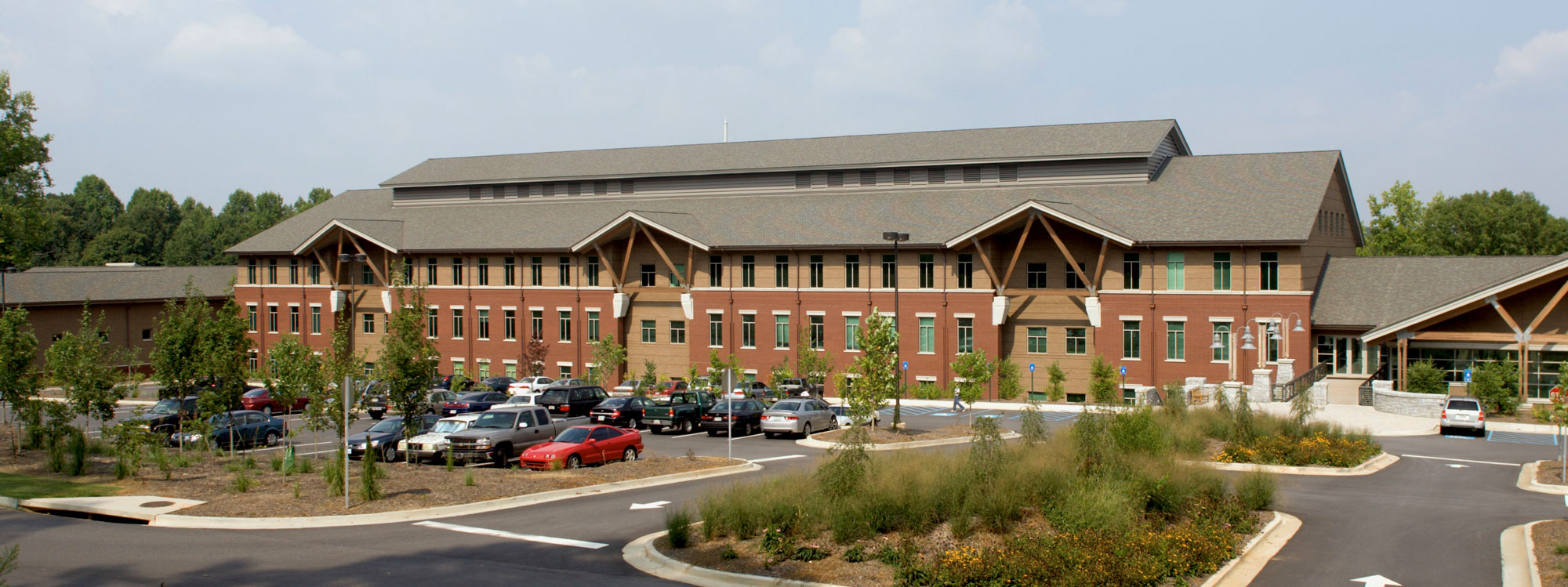
exterior of University of Georgia Complex Carbohydrate Research Center
The CCRC is one of the world’s leading organizations for the study of carbohydrates, also known as glycoscience. Based in a 140,000-square-foot facility near the UGA campus, CCRC will provide a home for the BioFoundry: GREAT project’s user facility, intended to educate, serve, and train aspiring glycoscientists and help democratize the potential for new advances in health and other applications possible through carbohydrate science. (Photo by Paul Efland)

Three-part strategy

As its name implies, the BioFoundry will focus on three activities to spread the gospel of glycoscience: resources, education, and training, all to be made available to collaborators and clients through a dedicated user facility that will be based at CCRC. The first component—resources—capitalizes on the center’s world-renowned collection of research talent. The idea is to leverage CCRC’s research and technology development to provide better tools for new and aspiring glycoscientists to use in their work.

For example, enzymes are critical to the formation and structure of glycans. Kelley Moremen has spent decades studying the biochemistry, structure, and regulation of enzymes involved in the creation of glycoproteins. One of the resources BioFoundry will make available are those very enzymes.

ā€œWe’ve focused historically on mammalian enzymes,ā€ said Moremen, Distinguished Research Professor at CCRC, ā€œbut now with the BioFoundry, we have a mandate to expand that to an all-species space, from bacteria to plants to microbes—basically all of biology—to understand the enzymes involved in glycan production, how they work, and what are the types of structures they make.ā€

Moremen, Wells, and CCRC Assistant Professor Breeanna Urbanowicz also will work with Professor Natarajan Kannan, Georgia Cancer Coalition Distinguished Scholar, to create computational resources that use artificial intelligence and machine learning to exponentially expand what is possible in carbohydrate research. Kannan is a member of the UGA Institute of Bioinformatics, and both he and Urbanowicz have appointments in the Franklin College of Arts & Sciences’ Department of Biochemistry and Molecular Biology.

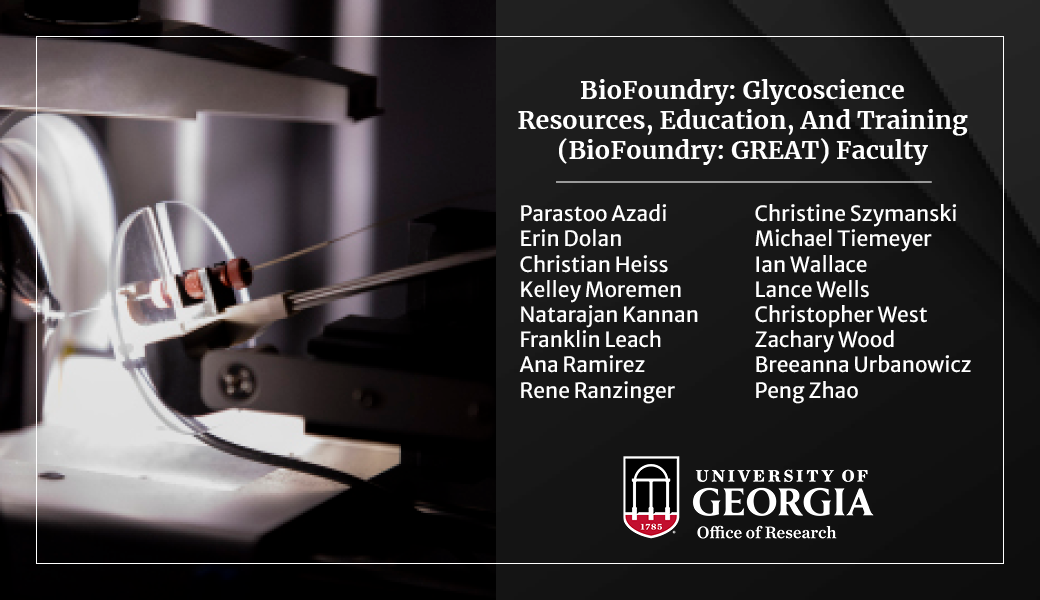
BioFoundry: Glycoscience Resources, Education, And Training Faculty: Parastoo Azadi, Erin Dolan, Christian Heiss, Kelley Moremen, Natarajan Kannan, Franklin Leach, Ana Ramirez, Rene Ranzinger, Christine Syzmanski, Michael Tiemeyer, Ian Wallace, Lance Wells, Christopher West, Zachary Wood, Breeanna Urbanowicz, Peng Zhao

Teaching glycoscientists to fish

Glycans are a basic building block of life, and the surfaces of all biological cells have a complex and diverse coating of glycans that greatly influence interaction and communication with other cells.

But theĀ applicationsĀ of glycobiology go far beyond the medical life sciences. Multiple CCRC researchers study the role of carbohydrates inĀ the production of biofuelsĀ and have leadership roles in organizations like theĀ Center for Bioenergy InnovationĀ at Oak Ridge National Laboratory. Others study how glycans are involved in the production of plant-based new materials.

Researchers working in these areas and more will be welcomed at the BioFoundry user facility, which is intended to be a full-service operation. CCRC’s Analytical Services & Training (AST-CCRC) unit, one of UGA’s core research facilities, provides instrumentation services and hands-on training for clients around the world. Parastoo Azadi, executive technical director of AST-CCRC, will also oversee the BioFoundry user facility.

Just like AST-CCRC, that user facility will be happy to perform analyses and instrumentation work for BioFoundry clients—free of charge, provided their goals align with the project’s mission—but the emphasis will be on giving clients the training and tools to do the work themselves.

ā€œThrough this facility, we’re going to interact with scientists in different disciplinary areas,ā€ Azadi said. ā€œWhether they’re in the plant area, bacteria and microbial area, mammalian proteins, and whether they are interested in industrial applications, medical applications, production of biofuels or new materials—all of these people can come to this hub and get what they need.

ā€œWe will create training and education programs for them so they can do this themselves. That’s a major component—weĀ wantĀ them to do it themselves.ā€

Not only does the NSF award allow potential clients to have their analytic work done at a greatly reduced price or even for free, it even provides funding to bring clients to Athens for short training residences.

ā€œWe’ve been doing training at CCRC for a long time, but the reality is we have a lot of reallyĀ high-end instrumentation,ā€ Wells said. ā€œIf you’re not from a big research school, you come here, you get trained, and then you go back to your university but you don’t have a 900 MHz NMR (nuclear magnetic resonance) machine.

ā€œOne of the things we’re doing with the training aspect,ā€ he said, ā€œis actually bringing people in longer term and allowing them to do their project here with our cutting-edge instrumentation.ā€

ā€œWe want glycobiology to become part of what we think of when we think about life science, both on the education and the research side.ā€

– Lance Wells, Principal Investigator, Distinguished Research Professor, and Georgia Research Alliance Distinguished Investigator at CCRC

Playing the long game

Perhaps most important for glycoscience in the long term is the BioFoundry’s third major component: education.

ā€œMost people, when they think of carbohydrates, think of sugar icing on donuts, or how you nutritionally bring in carbs and convert them into energy,ā€ Moremen said. ā€œThat certainly is part of the role of carbohydrates in biological systems, but most people are completely naĆÆve to the massive collection of other carbohydrate functions. Eventually, carbohydrate science needs to be inserted into teaching modules at all levels.ā€

That’s where co-investigator Erin Dolan comes in. Dolan, Meigs Distinguished Teaching Professor and Georgia Athletic Association Professor of Innovative Science Education in Franklin College, focuses her research on student learning, development, and success. She will lead an effort to develop educational experiences that promote the BioFoundry’s mission, such as glycoscience modules for existing chemistry or biology courses, standalone courses for undergraduate and graduate students, and hands-on summer courses for beginners.

ā€œThe fact that we entirely neglect the sugar chains that influence the functions of all the other biological components is deeply problematic,ā€ Dolan said. ā€œWhen you’re talking about glycoscience research, you’re talking about the next generation of scientists. How do we build capacity in that scientific community? You have to think about humans, and that’s the perspective I bring to this: I study humans.ā€

Dolan’s work initially will focus on raising the visibility of glycoscience in undergraduate and graduate education to a level comparable to the other elements of biology. But she is also playing the long game of influencing K-12 curricula by trying to make carbohydrate science a foundational aspect not just of science education, but in the education of science educators.

ā€œI don’t think any of us envision going into high school classes and taking over curriculum,ā€ Dolan said. ā€œBut think about where teachers take their science coursework: They take it as undergrads, right here at UGA or across the country at their undergraduate institutions. If we can make sure that future teachers have access to this information, that allows us to have an impact on high school education much bigger than simply focusing on classrooms in Athens.ā€

ā€œIf we listen to others in our field, including our key personnel associated with the BioFoundry ā€ Wells said, ā€œif we provide resources to the laboratories through research and technology development, if we provide education materials at all levels, if we work closely with industry to provide new tools, if we provide better and more thorough training, and if we bring it all together, we’re going to have some exciting discoveries that will lead to commercial applications in bioengineering, biomaterials, biomedicine and bioenergy, as well as increasing knowledge of glycans in classrooms and research labs across the globe.ā€

Categories
Uncategorized
brad-phillips

Brad Phillips

Director, Biomedical & Translational Sciences Institute and Director, UGA site of Georgia-CTSA

email: bgp@uga.edu

Connecting to clinical and translational resources