Generic selectors
Exact matches only
Search in title
Search in content
Post Type Selectors
Search in pages

Author: slquinlan

Steven Stice

Regents’ Entrepreneur Award 2023

University of Georgia researcher Steven SticeSteven Stice, D.W. Brooks Distinguished Professor, Georgia Research Alliance Eminent Scholar Chair in Animal Reproductive Physiology, and director of the Regenerative Bioscience Center, has led industry and academic research teams in the area of pluripotent stem cells for over 25 years. Stice has co-founded five companies and been issued 69 domestic and international patents. His first company, Advanced Cell Technologies, was the first to secure a U.S. patent on animal cloning and therapeutic cloning from adult animal cells. His current company, ArunA Bio, focuses on drug treatments for neurodegenerative and neurological disease and is beginning its first clinical trials in 2023. ArunA Bio was the first company to commercialize a product derived from human pluripotent stem cells and cell development, which was used to facilitate approval of Pfizer’s current cognitive-enhancing pharmaceuticals. Stice continually plays a vital role in promoting entrepreneurship in the Athens and Georgia bioscience communities.

Biao He

Regents’ Entrepreneur Award 2023

University of Georgia researcher Biao He

Biao He, Fred C. Davison Distinguished University Chair in Veterinary Medicine, is a renowned virologist and vaccine developer who has founded numerous biotechnology companies. His UGA research has led to four issued U.S. patents and 19 foreign patents. He’s work on the virus known as PIV5 has been translated into vaccines and treatments for deadly infections like rabies, tuberculosis, and HIV. The Georgia Research Alliance-funded startup company CyanVac is developing vaccines against several animal and human diseases based on He’s research. More recently, he founded Blue Lake Biotechnology, Inc., to develop PIV5-based vaccines for human disease with an initial focus on respiratory syncytial virus. In 2019, Blue Lake secured private investment to fund RSV vaccine development and has expanded to intranasal COVID-19 vaccine development in 2020. Blue Lake Biotech has shown promising phase 1 clinical trials for its intranasal COVID vaccine and intranasal RSV vaccine. He served on a White House panel to advise on the future of COVID vaccines.

Justin Stilwell

Robert C. Anderson Memorial Award

Justin Stilwell completed a rigorous five-year combined anatomic pathology residency/Ph.D. program at the UGA College of Veterinary Medicine in 2021. In addition to the multi-species aspect of his residency, he sought specialized training in the pathology of aquatic animal diseases. His research spanned infectious diseases and cancer biology in a variety of exotic and aquatic animal species. Stilwell’s dissertation work elucidating the pathogenesis of myxozoan infections in catfish could lead to significantly lower fish losses through the development of management strategies to mitigate and prevent outbreaks. Now a clinical assistant professor of veterinary pathology in the Department of Pathobiology and Population Medicine at Mississippi State University, Stilwell is applying his UGA training to investigate disease processes in marine mammals and sea turtles dying on the Mississippi Gulf Coast. He is poised to make many further contributions to the knowledge of aquatic animal health and advance the role of veterinarians in science, agriculture and translational medicine.

Ehsan Latif

James L. Carmon Scholarship

Ehsan Latif, a Ph.D. student in the School of Computing, is an exceptional scientist who has demonstrated significant productivity, creativity and insightfulness. Latif works at the computing intersection of advanced algorithms and wireless networking innovations for multi-robot systems. He is developing methods to improve multi-robot systems in coordinating their actions for localization and exploration. These systems must know their individual locations while continuously communicating with each other so they can perform complex tasks and interact with human observers (such as collaborating with first responders in post-disaster search and rescue efforts. Latif’s research has led to algorithms that provide high localization accuracy and efficient exploration for robots while reducing communication and computational demands. He also explores the use of network-related devices like sensors to solve problems, such as localizing robots in unknown environments and designing new frameworks for multiple robots to collaborate. He exploits dynamic reinforcement learning with optimized usage to provide efficient exploration.

Alison Banks

James L. Carmon Scholarship

Alison Banks, a doctoral student in the Department of Geography, applies critical state-of-the-art Earth system modeling to understand how climate change affects global air quality. Each rainfall event cleanses the atmosphere of harmful pollutants (such as particulate matter), but climate change is redistributing rainfall patterns and frequency across the globe. Conventional representation of rainfall in climate models tends to bias rainfall as “too-light-and-too-frequent.” By crafting a simulation where particle emissions are held constant, combined with a new technique that represents clouds at all scales, Banks is developing a model that could help identify areas where air quality is deteriorating because of climate change. Her research advances scientific understanding of rainfall patterns and the health impacts of harmful air quality events.

Robert L Foster

Non-Tenure Track Faculty Research Excellence Awards 2023

Photograph of Robert Foster

Robert L. Foster, senior lecturer in the Department of Religion, has received excellent reviews from major figures in his field for his innovative 2019 book, “We Have Heard, O LORD: An Introduction to the Theology of the Psalter,” published by Lexington/Rowman & Littlefield. It is one of only a few books in the last two centuries to explore various portraits of God within the 150 psalms of the Book of Psalms in the Hebrew Bible. Analyzing the original Hebrew text, Foster focuses on different psalmists’ rhetorical strategies, offering close, linear (canonical) readings with ultimate attention devoted to the divine subject. He shows how psalmists portray God’s character and God’s actions to persuade their respective audiences, whether that audience is human (preaching) or divine (prayer). Reviewers have especially praised the book for its readable style and accessible format, allowing Foster to communicate his ideas to both academic and non-academic readers.

Dehai Zhao

Non-Tenure Track Faculty Research Excellence Awards 2023

Photograph of Dehai Zhao

Dehai Zhao, senior research scientist at the Warnell School of Forestry and Natural Resources, is among the top quantitative forest scientists in the world. A leader in forest biometrics, he focuses primarily on issues of tree growth and yield in intensive southern pine plantations. But his work covers a wide range of topics and approaches, including analyzing long-term experiments, assessing foundational biological and silvicultural concepts, and exploring and developing the frontiers of forest biometrics. Zhao has also served as a longtime associate editor for Forest Science, the premier global journal in his discipline. As he moves his research specialist’s discipline forward, he has produced a steady stream of more applied studies to address stakeholder questions and problems, helping improve silvicultural and management practices of southern pine and mixed-species forests. His strong record of externally funded research, scholarly publication and collaborative skills have influenced how millions of acres of forestland are managed. 

Earl Cooper

Non-Tenure Track Faculty Research Excellence Awards 2023

Photograph of Earl Cooper

Earl “Bud” Cooper, clinical professor in the Department of Kinesiology, is a world leader in optimizing heat safety and sports through research, education and advocacy. He has demonstrated consistent research excellence since his arrival at UGA in 2008, successfully competing for extramural funding and publishing foundational studies on heat hazards for collegiate and high school athletes. The critical importance of work is best captured by the fact that Cooper has saved the lives of young athletes in Georgia and elsewhere. He led a six-year study that resulted in changing practice policies for high schools in Georgia in 2012, reducing potentially life-threatening heat illnesses by up to 60%. His research on modifying exercise based on WBGT (Wet Bulb Globe Temperature) metric has made Georgia the leader in this safety measure. Cooper’s research has been cited as critical evidence in guiding effective hot-weather sports participation policies in several states around the country and is cited in numerous national consensus statements.

Parastoo Azadi

Non-Tenure Track Faculty Research Excellence Awards 2023

Photograph of parastoo azadi

Parastoo Azadi is the  associate director of the Complex Carbohydrate Research Center for service and training, as well as a senior research scientist and globally recognized expert in the field of glycoscience. With a rare breadth of expertise, she guides analyses of microbial, viral, plant and animal glycans, helping drive progress in glycobiology in academia and industry. For nearly three decades, Azadi has directed the world’s leading center for glyco-analytics techniques, the CCRC’s Analytical Services and Training Laboratory. She’s led multi-million-dollar efforts to develop improved tools for glyco-analytics, co-authored more than 200 peer-reviewed manuscripts, and is principal investigator for the CCRC’s Department of Energy-funded Center for Plant and Microbial Complex Carbohydrates. At the onset of the pandemic in 2020, hers was among the first groups in the world to report on the sugar chain structure on SARS-CoV-2’s spike glycoprotein and later studied glycosylation differences in the five SARS-CoV-2 variants, including the highly transmissible Delta and Omicron strains. 

Team Impact Award 2023

Team Impact Award 2023
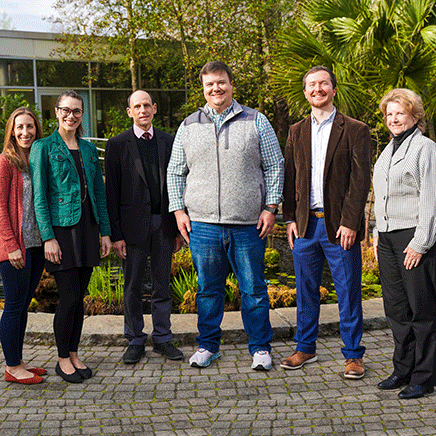
Photograph of CARE Team

The UGA Cognitive Aging Research and Education (CARE) Team is tackling one of the most debilitating public health problems faced by Georgians: Alzheimer’s disease. CARE is a clinical, research and outreach program delivering brain health education, improving access to diagnosis, conducting cutting-edge research and providing support for families affected by dementia. Inside the CARE hub, the team has already provided diagnosis and post-diagnosis support to more than 100 local families and counting. Outside the hub, the CARE team serves 11 geographically, racially, ethnically and economically diverse rural communities. CARE begins by learning about community needs from local stakeholders affected by dementias. Then, the team translates what it learns into a tailored action plan that guides CARE’s work in creating a dementia-informed community, removing barriers to accessing a diagnosis and providing support to caregivers. Finally, the CARE team works with each community to achieve the goals in its unique action plan and studies the impact.